Evil Eye Tattoo Meaning: Protection, Colors & History + Free Stencil
Some symbols survive empires. The evil eye — that unblinking blue-and-white stare you’ve seen on bracelets in Istanbul, doorways in Athens, and now on forearms everywhere — has been protecting people for over five thousand years. It predates most religions that use it. And here’s the part I love as someone who draws it weekly: the design has barely changed in all that time. Concentric circles, a steady gaze, a promise: whatever is aimed at me, this catches first.
The evil eye has quietly become one of the most requested small tattoos of the decade — and one of the most misunderstood. People regularly ask me whether wearing it is bad luck (it’s the opposite), whether it’s religious (older than that), and whether a tattooed eye “works” like the glass amulet (depends who you ask — we’ll get there). In this guide: the real history and meaning, what the colors signify, the nazar vs. the eye-symbol distinction most guides miss, 22 design ideas, placement advice, and my free hand-drawn evil eye stencil at the end.
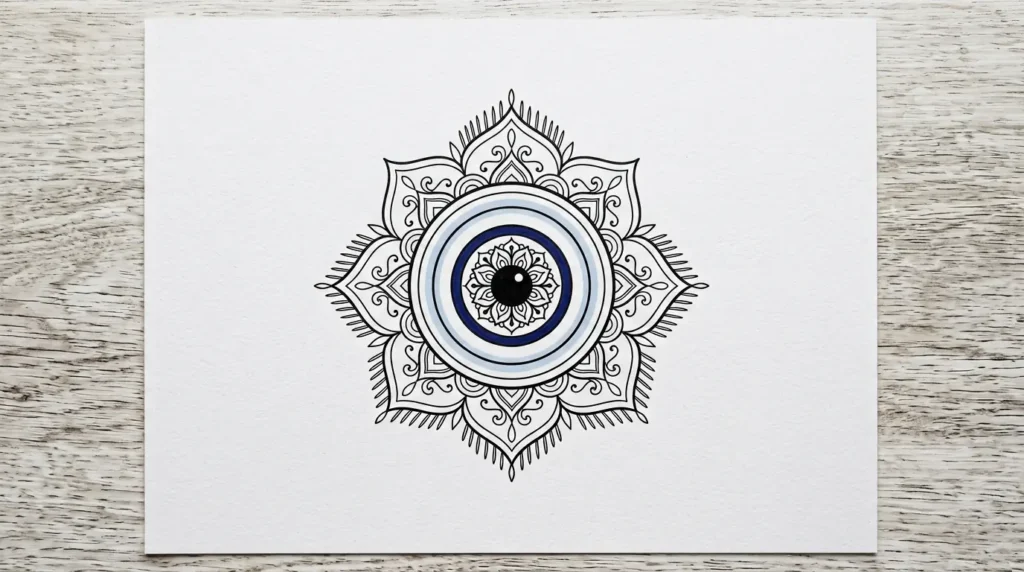
What Does an Evil Eye Tattoo Mean?
An evil eye tattoo is a protective symbol — it represents a watchful guardian that absorbs envy, jealousy, and ill will before they can reach you. Despite the name, the tattoo isn’t “evil” at all: the evil eye is the harmful gaze others might cast at you (often unknowingly, through envy), and the amulet — the eye you wear — is the shield that catches it. Wearing the eye means you take negativity seriously enough to guard against it, and lightly enough to let a symbol do the worrying.
Five Thousand Years of the Watching Eye
The belief that an envious gaze can cause real harm appears on Mesopotamian clay tablets from around 3,000 BCE, in ancient Egypt, across classical Greece and Rome — Roman soldiers wore eye charms into battle — and it runs through Turkish, Greek, Arab, Jewish, Hindu, and Latin American cultures to this day. Almost every Mediterranean and Middle Eastern grandmother has pressed a blue glass eye into a grandchild’s hand at some point. When you tattoo this symbol, you’re joining one of the longest unbroken chains of shared belief in human history — that’s not decoration, that’s continuity.
The Nazar vs. the Eye Symbol — Know the Difference
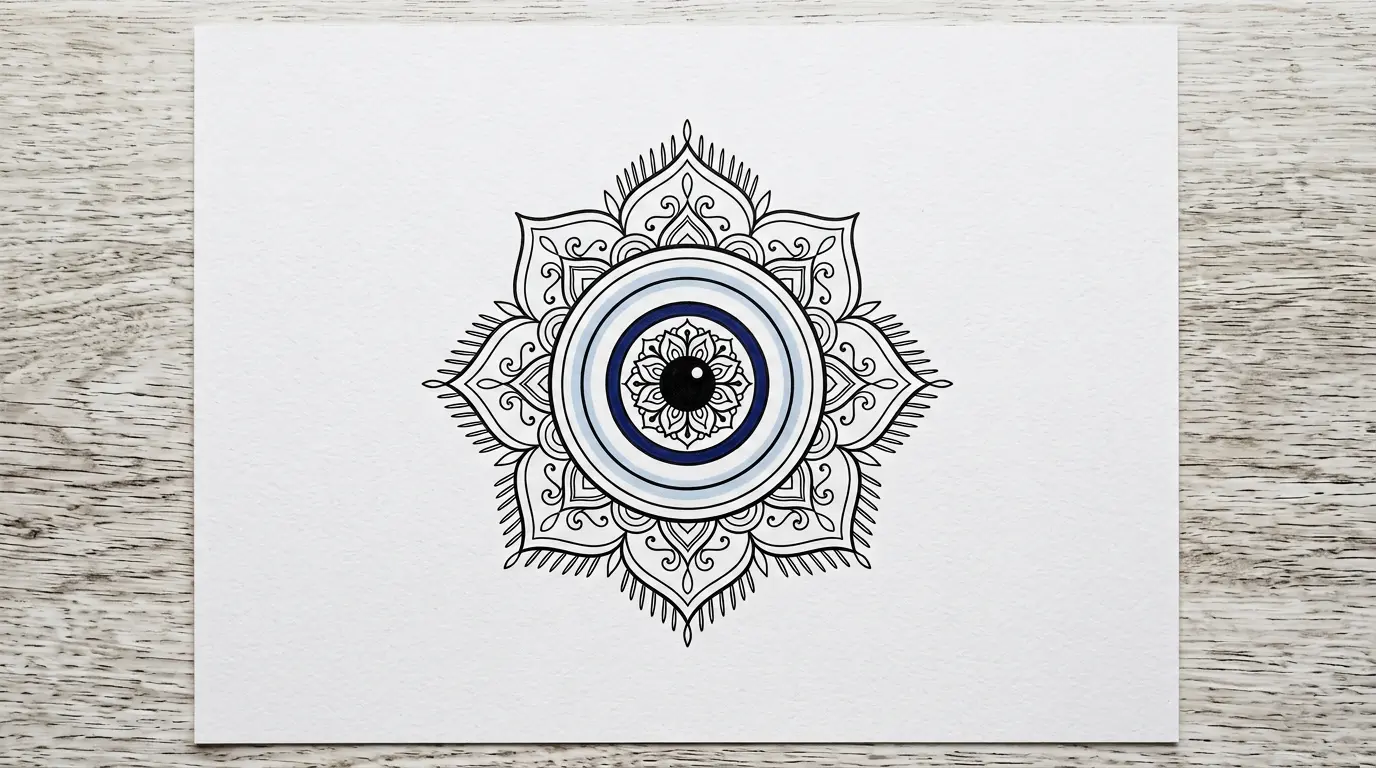
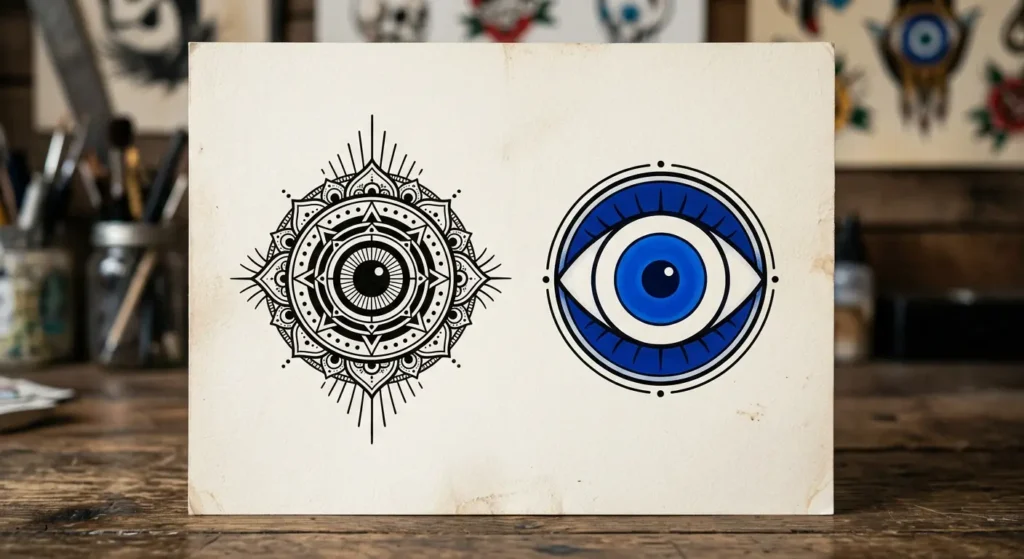
Here’s the distinction most tattoo guides skip, and the first thing I clarify when someone requests this design. The nazar is the specific Turkish-Greek amulet: concentric circles of dark blue, white, light blue, and a black center — the “eye” is abstract, made of rings. The broader eye symbol is a drawn human eye, often with lashes and an iris, used in countless protective traditions. Both protect; they just speak different visual languages. The nazar reads as cultural and geometric; the drawn eye reads as personal and organic. Decide which one is yours before you book — it changes the entire design direction.
Protection From What, Exactly?
Traditionally: envy. The old belief holds that admiration with a drop of jealousy in it — even unintentional — can curdle into harm. Modern wearers translate that into today’s language: toxic energy, bad intentions, people who smile at your face and drain you behind your back. More than one person has told me, while requesting this design, some version of: “I got promoted, and suddenly I needed this.” The evil eye is the tattoo of people who’ve learned that not everyone clapping is celebrating.
A Note on Wearing It Respectfully
The evil eye belongs to many cultures simultaneously, which makes it broadly open to wear — no single tradition owns it. That said, it’s a living belief, not an aesthetic: in Turkey, Greece, and across the Middle East, people genuinely hang nazars on newborns’ cribs. Wear it knowing what it means and the symbol carries you; wear it as a random trend and you’re carrying expensive jewelry you can’t take off. As I tell everyone: informed ink is good ink.
Evil Eye Tattoo Color Meanings
The classic nazar is blue for a reason — but the amulet tradition actually assigns different protections to different colors. If you’re going beyond blackwork, this is the cheat sheet:
| Color | Traditional Protection | Often Chosen By |
| Dark blue | The classic — karma and fate protection, calm | First evil eye, traditionalists |
| Light blue | Peace, broadened perspective, solitude | Overthinkers seeking quiet |
| White | Purity, fresh starts, clearing clutter | New chapters |
| Red | Courage, energy, protection in love | Bold hearts |
| Green | Success, growth, new opportunity | Founders, fresh graduates |
| Yellow/Gold | Health, relief from exhaustion | Healers and the healing |
| Black | Power, mystery, absorbing negativity totally | Blackwork lovers (and it ages best) |
A color note from my drawing desk: the nazar’s deep blue is gorgeous in ink, but blue pigment softens noticeably faster than black. If you want the tattoo crisp at year ten, my honest recommendation is black linework with one blue element — the center ring — rather than a fully saturated blue eye. You keep the cultural signature; you lose almost none of the longevity.
22 Evil Eye Tattoo Ideas
Minimalist & Micro Evil Eyes (1–8)
1. Micro nazar — four concentric circles, under an inch; the amulet at its purest.
2. Single-line evil eye — the whole symbol in one unbroken stroke.
3. Fine-line eye with rays — thin sunburst lines radiating from the gaze.
4. Dotwork nazar — rings built from stippling; soft but unmistakable.
5. Tiny eye on the inner wrist — the guardian facing whoever reaches for you.
6. Behind-the-ear eye — watching your blind side, literally.
7. Finger evil eye — bold micro placement (read the fading FAQ first).
8. Ankle nazar — an old folk placement: protection that walks with you.
Symbolic Combinations (9–16)
9. Evil eye in a teardrop — the classic amulet silhouette, point down.
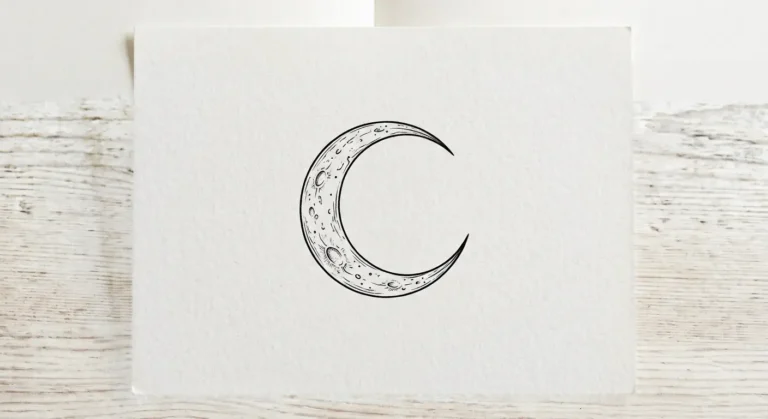
10. Eye with crescent moon — night watch; the guardian that never sleeps.
11. Eye with stars — guidance plus protection in one small cluster.
12. Eye in a sunburst mandala — ornamental rings radiating outward.
13. Evil eye with floral frame — soft petals around a steady gaze (pairs beautifully with a bloom like the one in my peony guide).
14. Hamsa with eye center — the protective hand cradling the eye; a rich tradition of its own worth researching before you choose it.
15. Eye with snake — double guardianship, two ancient protectors (the serpent’s full story is in my snake tattoo guide).
16. Matching evil eyes — two friends, each carrying half the watch.

Bold & Ornamental Evil Eyes (17–22)
17. Traditional blue nazar — full color, glass-amulet realism.
18. Blackwork evil eye — solid rings, maximum contrast, decades-proof.
19. Ornamental eye with filigree — lace-like flourishes framing the gaze.
20. Geometric eye — the circles broken into clean modern facets.
21. Eye on the nape — watching what approaches from behind; my favorite conceptual placement.
22. Sternum eye with rays — centered protection, symmetrical and striking.
Best Placement for an Evil Eye Tattoo
| Placement | The Symbolic Logic | Size Sweet Spot |
| Inner wrist | Guards what you give and receive | 0.5–1 inch |
| Nape (back of neck) | Watches your back — literally | 1–1.5 inches |
| Behind the ear | Covers your blind side | Under 0.75 inch |
| Forearm | Visible deterrent; fine detail stays sharp | 1–2 inches |
| Ankle | Protection on every path you walk | 0.75–1 inch |
| Sternum | Shielding the heart’s center | 1.5–2.5 inches |
| Spine (between shoulder blades) | The unreachable guardian | 1–2 inches |
My honest placement advice: the evil eye is one of very few designs where placement carries half the meaning — people genuinely choose spots for the symbolism (nape = watching your back) as much as the look. Design-wise, the nazar’s concentric rings need even spacing to read correctly: on high-flex areas like fingers and the side of the hand, the rings warp and merge faster than almost any other small design I draw. Wrist, forearm, nape, ankle — flat, stable, perfect. Fingers — beautiful for two years, blurry by year five.
Download My Free Evil Eye Tattoo Stencil (2 Versions)
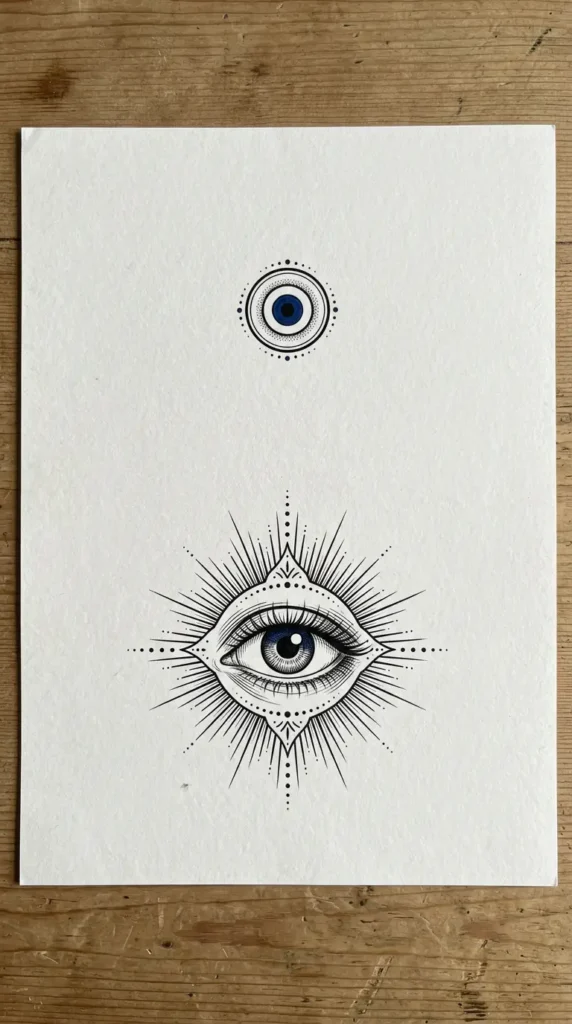
One PDF, two hand-drawn guardians: a micro nazar (concentric rings, sized for wrist or ankle) and a fine-line eye with rays (sized for forearm or nape). Both print at 100% scale. Print it, hand it to your artist, let it start watching. No watermark, no signup wall.
Watch Me Draw the Guardian
Ring by ring, until it’s watching back — the full process:
[🎬 TikTok/YouTube ভিডিও লিংক এখানে পেস্ট করুন — অটো এমবেড হবে]
Evil Eye Tattoo FAQ
Is it bad luck to get an evil eye tattoo?
No — this is the most common misunderstanding about the design. The “evil eye” is the harmful gaze; the symbol you tattoo is the amulet that blocks it. Wearing it is traditionally considered protective, not unlucky. One folk caveat exists: some traditions hold that a cracked or broken nazar has “used up” its protection — which is why I’d skip deliberately drawing it shattered unless that broken-shield story is exactly what you want to tell.
Is an evil eye tattoo religious?
It’s older than the religions that carry it. The eye-against-envy belief predates Christianity, Islam, and Judaism, and versions of it live inside all three, plus Hindu and folk traditions across continents. You don’t need any particular faith to wear it — though if you hold one, there’s likely an evil-eye tradition already inside it.
Evil eye vs. hamsa — what’s the difference?
The hamsa is the open-hand symbol (Hand of Fatima / Hand of Miriam) that often contains an evil eye in its palm — hand and eye are partners, not rivals. The hamsa carries its own deep tradition across Jewish and Islamic cultures and deserves its own research if you’re drawn to it. Short version: eye alone = the watchman; hamsa with eye = the hand that holds the watchman.
How much does an evil eye tattoo cost?
Micro nazars usually land at shop minimum — $50–$120 in the US. Fine-line eyes with rays or ornamental framing run $120–$250, and full-color traditional nazars with blue saturation more. Concentric circles look simple but demand a steady hand — uneven rings are instantly visible — so choose your artist for precision, not price.
Which way should the evil eye face?
Tradition doesn’t fix a direction — the amulet “watches” wherever it’s hung. Most wearers orient it outward (readable to others) on visible spots, since the deterrent is part of the point, and toward themselves on the inner wrist as a private reminder. The nazar’s rings are symmetrical anyway; for drawn-eye versions, choose based on who the message is for — the world, or you.
More Free Stencils & Ideas
• Another ancient guardian: Snake Tattoo — Meaning + Free Stencil
• Protection in numbers: the 444 Angel Number Tattoo Guide
• Browse all Small Tattoo Ideas + Free Stencils
• Explore Minimalist Tattoo Designs
🖋️ New stencil every week. Watch me draw them on TikTok and Instagram, or get 10 free stencils by email.